This analysis contains spoilers
A Welsh coastline, a tree, the TARDIS: the setting is established. It is simple, restrained, and it already says a great deal about what the episode is going to be. Then the Doctor enters, contrasting completely with both the setting and the image’s colour palette in his new costume. This is clearly a deliberate choice. In this much more realistic world introduced in a single shot, the Doctor arrives in an outfit that is far too neat, far too cliché, with that yellow coat all ready for the seaside. None of his costumes up to this point had truly matched a picture-postcard expectation, not even the one in The Devil’s Chord, which at least was trying to fit a specific era. This costume makes it clear that the Doctor does not inhabit the real world, but a fantasised one, and this episode is going to ask us to leave that fantasised world behind.
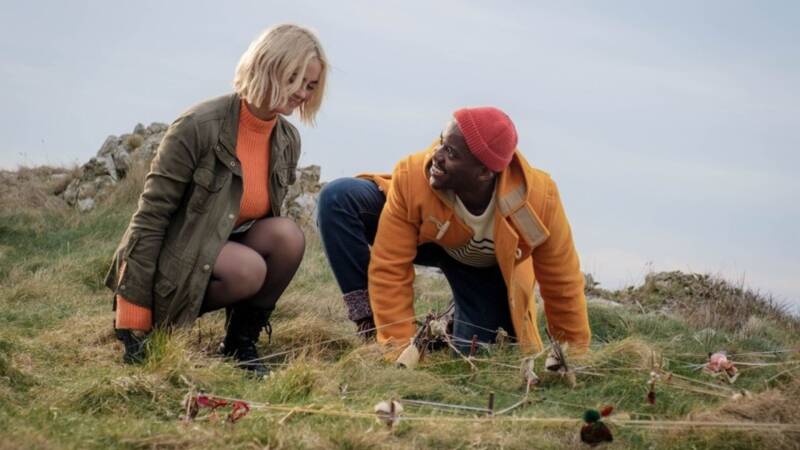
As he walks with Ruby, he mentions Roger ap Gwilliam, specifying that he was a dangerous man before remembering that, for Ruby, this belongs to the future and he does not want to reveal too much. At that moment, he steps on a magical fairy circle apparently made by people who believe in such things. Ruby finds a message there and reads it aloud: “rest in peace, Mad Jack.” She finds that odd, turns around, and the Doctor has vanished. No stylistic flourish, no special effect, just an absence. It is a powerful choice that fits perfectly into the broader reflection on the Doctor’s non-existence in our world. It is as though Ruby suddenly stops seeing her imaginary friend. The Doctor has barely even had time to introduce the episode. The music is unsettling and perfectly placed at that moment. In fact, the Doctor acts like that slightly old-fashioned conscience that twists your insides when you let it speak. It is the kind of conscience that makes us all say: nuclear war really is possible, and the planet, the rocks, and the sea will carry on when we are gone—let’s not kid ourselves. Ruby tries to open the TARDIS, but it is locked: no more access to the Doctor’s reassuring, imaginary world. She jokes that perhaps he is peeing behind the TARDIS, which is not exactly an elegant joke, but let’s allow it. It is also a way of showing that we cannot really imagine the Doctor doing something like that, having such basic bodily needs. It drives the point home: the Doctor does not really exist, not in that sense.
At that point, Ruby notices, in the distance, an old woman beneath the bent tree making strange gestures at her. The imagery is simply superb. The choice of location is fantastic, but above all it is the handling of distance that is so impressively rendered here, with the woman just far enough away not to be clear, but not far enough to be blurry. When Ruby approaches, the old woman is further away again, always at exactly the same distance from her. We never make out her face: she is entirely visible and yet still hidden. Ruby then crosses paths with a hiker she feels she recognises (and attentive viewers by this point will indeed have noticed it is the same face that appears in every episode). She asks the hiker, who is heading in the old woman’s direction, to pass on her apologies in case she has unknowingly wandered onto private land. The hiker goes, and still filmed from a distance, we see that the old woman does not move any further away, but the hiker suddenly panics and runs off. The atmosphere shifts radically as the music becomes more and more anxiety-inducing, with whispers threading through it.
Ruby, disoriented, heads to the nearest Welsh village. Night is falling as she enters a pub. Through the window, the old woman is still there, at exactly the same distance. The pub’s customers stare at Ruby with suspicion. It almost feels like the iconic opening scene of An American Werewolf in London. She asks the landlady for a room for the night, and that landlady is played by the same actress who appeared in the Torchwood episode Countrycide back in 2006. The connection with what those spin-offs were trying to do is therefore obvious and extra-diegetic: this episode is almost a Doctor-less spin-off all by itself. Ruby tries to pay for her room with her phone (personally, I don’t even know how to do that, so I felt ancient), and the landlady pretends not to know what a telephone is. It is very well played because it is useful both in undermining the assumptions viewers might have about the countryside and, more importantly, in creating a moment of unease where we wonder whether Ruby is really in our time or decades earlier.
Everyone then looks out at the woman through the window, and an older lady at the bar doing a crossword puzzle suggests that someone should go and ask her why she is following Ruby. Josh, a man finishing his last pint, volunteers. Ruby asks him to ask the woman whether she has seen the Doctor. Josh, who serves as the group’s over-fifty male representative, heads outside. At that point, Ruby is filmed through the window from outside, in a slight forward movement that creeps closer to her while she is saying that the old woman always keeps her distance. The direction in this episode makes genuinely pertinent use of its visual effects. The elderly woman at the bar suggests a new word, “semperdistans,” meaning always at a distance, which I think is rather lovely. Normally that is exactly the sort of observation the Doctor might make, and here it is given to an entirely different character, showing that the Doctor does not have a monopoly on that sort of insight.
One of the two young people then sees Josh running away, just like the hiker earlier. It is unsettling, but when Ruby mentions the fairy circle, the atmosphere changes completely. Everyone suddenly becomes worried, and the staging follows suit. When the word “fairy” is used, meaning both “fairy” and, in slang, an insult for a gay man, the young woman mocks her punk-rock-styled friend with “you can ask him about that.” I am not quite sure what to make of that: is it a way of showing that even the younger generation can be deeply irritating, or of showing that beneath the surface of youth and openness, bad behaviours still flourish today? Whatever the case, at that point the shot compositions change and the characters are filmed from slightly lower angles, as though to evoke genre-film anxiety. Only the old woman is filmed without that low-angle treatment as she speaks in a very slow forward tracking shot. She explains that cliffs are liminal spaces where the rules are suspended, a place that is not really there. One might well wonder whether RTD is talking here about his own desire, for once, to suspend the rules, and whether he deliberately had the TARDIS land there for that reason. Suspending the rules—or rather the main rule—means making an episode without the Doctor. Consciously or not, is he trying to say that the Doctor bores him now? That the Doctor prevents him from telling the stories he wants to tell? That there are too many rules? Too many constraints from production and broadcasters?
What follows is a really violent notion: the landlady says that Wales is a pool of blood produced by English torture. The elderly woman adds: “it is said he walks through the gaps, the spiteful one.” Could this be a god of the Pantheon who does not appear because he is invisible? Something intensely symbolic? We quickly return to the plot when Ruby says she read a note about Mad Jack, and the direction goes slightly mad: creepy shots of the old woman are followed by a tilted shot with lightning straight out of a Hammer horror film. Aaaand in fact they were just messing with Ruby, lol, those legends are not real, haha, so funny! Except then someone knocks at the door and everyone panics. It is Mad Jack!! Well no, it is just the delivery man. And then the old woman accuses Ruby of being racist because she took them for druids and witches—but first, Ruby never said that, they are the ones who amused themselves by making her believe it while she was alone and lost, and second: that is really not what racism is.
Ruby looks outside: the old woman has not moved, night gives way to day, and the woman is still there. In the morning, Ruby eats a yoghurt and the landlady gives her warm clothes. She goes back to the TARDIS and waits. For a long time. The shots of her sitting still while being shown in different places (outside, then back in the pub) foreshadow the identity of the old woman, and the episode is not really playing for one huge final twist, even though obviously there is one, and that is excellent because the twist is not the point. Josh has apparently told the landlady “ask her” when she asked why he did not return, so Ruby thinks she has to ask the old woman. But the landlady wants Ruby to leave, and Ruby is then completely isolated by the staging. She returns to the TARDIS and says something very true and, once again, genuinely important: she does not actually know the Doctor all that well after all, and she is going to go home. Again, that is a significant statement coming from a companion, because it deliberately breaks the illusion that companions and the Doctor have been travelling together forever.
On the train to Paddington station (where, disappointingly, the ticket inspectors are not bears in red hats), she sees the woman in the streets, the fields, and so on—showing that the woman does not move, since that would be impossible, but rather “appears” without appearing, always at a distance. Back home, Cherry tells Ruby that the Doctor is “no good with his box of magic tricks,” continuing this season’s ongoing emphasis on magic. She even says the Doctor is like any other man with his secrets. That is a very personal RTD vision, because the Doctor is not always a man, but for him that is very clearly what the Doctor represents. It really does feel as though RTD is disappointed by the Doctor, though that remains a totally unverifiable and probably mistaken hypothesis. Ruby is once again filmed through a window, still isolated by something invisible through the staging. Carla decides to go and see the woman with her phone so that Ruby can hear what happens. At that moment, Mrs Flood, the neighbour, comments on the situation with “nothing to do with me,” which suggests there are other things that do have something to do with her. It is subtle, but it is there.
Ruby asks her mother what the woman looks like, and Carla replies, “she looks like what she looks like,” before running off. And here the choice of framing, focal length and music is absolutely chilling: the close-up on Carla, the taxi window that isolates Ruby from her mother, the sheer force of the sound design. Ruby goes home, tries to call her, and the next day the same thing happens… Eventually Ruby can no longer get into the house because her mother has come back and changed the locks. Once again Ruby remains in the same place while day turns into night. Carla then says the worst possible thing to Ruby: “even your own mother didn’t want you,” and Ruby is filmed behind the skylight with rain falling outside. The Doctor is not there to deal with the hardest, most serious emotions. The Doctor “does not exist.”
The episode then uses an ellipsis to bring us to Ruby sitting at a café terrace, meeting Kate Lethbridge-Stewart from UNIT. She reminds us, as we already know, that she helps former companions of the Doctor find work. It almost feels as though the Doctor is being presented here as a horribly toxic person who drops you once he has spent time with you, and the series is fully acknowledging that. Kate introduces UNIT by saying that they investigate alien phenomena, but more and more also the supernatural: excellent promise!! She explains that the woman who “follows” Ruby has a sort of perception filter like the TARDIS, and Ruby has measured the distance: she is always exactly 73 yards away. Ruby also does not dare take a plane or a boat for fear of dying if she breaks the link (deep down, Ruby has understood that this woman matters to her and her life). We learn that even in photographs the woman cannot be seen properly; she remains blurry. So UNIT agents rush towards the woman with firearms, under Kate’s strict instruction that they must not speak to her under any circumstances—but they turn around anyway and leave. Even Kate, with her earpiece in, walks away. Ruby smashes a glass, shouts at a waitress, aaaaand CUT: Ruby, now with long hair, is 25 and living alone.
She has a boyfriend, but her life remains stagnant. At 30, through the window of her flat, we see her moving away from another boyfriend. At 40, the same again. At heart, her history with the Doctor has left her with a fixed image inside herself that keeps poisoning everything. The episode does not say that this is the Doctor’s fault, but the subtext very well might. That is when Ruby sees Mad Jack on television in a bar. She tells some man to get lost because she has understood that she must save the world from the nuclear crisis the Doctor mentioned at the start. She has grown used to the old woman’s presence and joins Mad Jack’s political campaign. We then see her backstage at one of his interviews, where he talks like any populist: he does not answer questions and wants to defend Wales with nuclear missiles, even hinting that he could actually launch them. When he is close to Ruby, as long as she does not look directly at him he remains blurry—yet he is looking at her. He approaches her and asks who the uncomfortable woman at the back of the room is. He mocks the fact that the woman has a boy’s name (Marty) and goes to shake her hand. We then learn that he has been elected Prime Minister. That feels obvious now because we know today it is possible, but twenty years ago that transition might have seemed unbelievable. So the episode is strong for handling it this way. It is chilling because we know.
In the headquarters of the far-right party, Ruby sees the distressed woman and is told that this man is a monster (well yes, astonishingly enough). We then find Ruby on a football pitch with a group of people. They are told not to step onto the grass (the woman Ruby sees is in the stands). Obviously Mad Jack has chosen a football ground for his inaugural speech because he “speaks to the people.” He stands on a platform, and one man explains that he is really cool “because he says hello to everyone” (wow… truly low standards…). It is an excellent observation, though, because people often stop at exactly that kind of façade. And immediately afterwards, the organiser, who is a fervent partisan, tells Marty—the woman Mad Jack abused—that she has been invited to the evening event. Like Ruby, we can feel that the pieces are beginning to fit together. “They say Saturday is when control transfers”: Mad Jack is going to declare Welsh independence from NATO and obtain the nuclear codes, perhaps even actually launch a bomb. We are very far here from the usual sort of fictional stakes in Doctor Who. Ruby then walks onto the pitch while the organiser asks her for a coffee (yes indeed, the disconnect is total). She keeps walking without stopping despite repeated demands: they seem genuinely frightened of a woman walking, which is symbolically very apt. The music swells, Ruby checks the distance on her phone and reaches 73 yards from Mad Jack. The old woman speaks to him, he drops everything and runs away. Marty and Ruby laugh. Mad Jack resigns and says only, “ask her.” The actor is exceptionally well cast, incidentally.
Because we are still, after all, in a kind of feel-good fictional world, the new Prime Minister promises to be nicer. Ruby, back at home, speaks to the woman outside and asks her to leave. And then an ellipsis takes us forty years later. Ruby, now very old, gets out of a car on the cliff to find the TARDIS again. The old woman is still there. People leave flowers at the TARDIS without knowing why; the music is calm. The TARDIS has almost put down roots. Deep down, it gives me the impression that the TARDIS really represents people’s hope for a better life, like any supposedly magical artefact, like fairy circles or the sort of esotericism that often comes roaring back when the world is sliding into fascism. It is the need for stories. Ruby has never found her biological mother, Carla has never contacted her again, and it has never snowed since. The old woman is there because Ruby had hope and dared to hope. Another ellipsis takes us to a care home: Ruby is asleep, there are whispers, she switches on the light and there—such a folk-horror image, so very “elevated horror,” if that term means anything. The old woman, seen from behind, is close. She moves nearer. The sound of a heartbeat. The sequence is masterful. The woman turns around, Ruby reaches out, and suddenly she is in the old woman’s place at the very beginning of the episode, watching her younger self and the Doctor come out of the TARDIS. We see the same scene again, except that now Ruby notices the woman immediately, and the woman whispers, “don’t step.” The woman vanishes. The Doctor does not seem to believe Ruby, which is very strange coming from the Doctor, but logical if we consider that he simply does not inhabit reality in the same way the old woman does. Ruby repeats “don’t step” to the Doctor, so he does not break the fairy circle. She does not remember the third time she went to Wales, naturally. So all of this happened in an alternative universe.
In the end, what we can see very clearly here is the fundamental difference in RTD’s approach to the Doctor. In RTD1, the Doctor became a kind of Christ-like figure full of very human emotion, whose existence and return were prophesied from the farthest reaches of the galaxy. In the Moffat era, the Doctor became the imaginary friend from children’s stories. In the Chibnall era, she was that mad scientific traveller, enthusiastic and only passing through. But in RTD2, the Doctor becomes the receptacle for humanity’s need to deceive itself in the face of the catastrophic state of the world, a state that very clearly terrifies RTD, as it terrifies a large part of the population. The condition of the world means that, for RTD, the Doctor can no longer truly be present, because he has no hold over what is happening. The very first episode already tells us that chance does not arrange things for the best; it is dangerous, even a sort of weapon for the goblins. Destiny is not something you can simply let act and tell yourself it will all sort itself out. Episode four therefore fits into an extremely logical thematic progression, haunted by a real feeling of dread about the impossibility of having a hero in the world as it is now.
Ajouter un commentaire
Commentaires