This analysis contains spoilers
At the start of the episode, we meet a piano teacher and his pupil, a child no older than ten, in an empty room in 1925. The pupil is bored, so the teacher shows him what music played with passion sounds like before mentioning the Devil’s Chord, easy to play and said by legend to summon the devil. And it works, because someone knocks from inside the piano: it is Maestro who emerges. The costume is magnificent, and the performance is fantastic. But already, a problem appears: what makes it that on this particular day Maestro is able to appear? The Devil’s Chord has supposedly been played since the Middle Ages, otherwise the teacher would not know it.
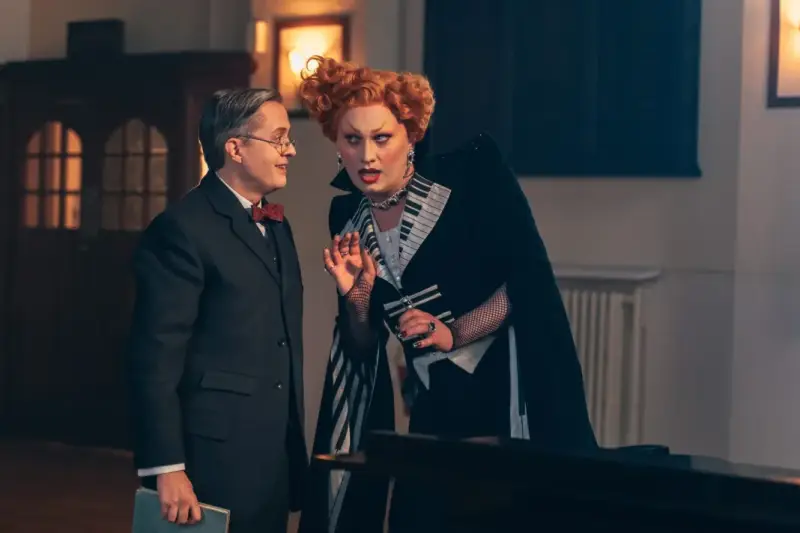
So Maestro could have appeared before, surely? And if so, they could already have devoured people’s music, and by 1925 the problem ought to be far more serious, right? And if all of this is linked to Maestro being unleashed by the events of the 60th anniversary, why does it happen in 1925? Any number of science-fiction tricks could explain this, but it should be mentioned and clarified, and it simply is not.
The teacher, who loves music passionately despite his rather minor civil-servant air, is the most interesting supporting character in the episode, and unfortunately he is given only this one scene. It felt obvious that focusing on a character for whom music has become a profession devoid of spark, confronted with children bored by music, would have been absolutely brilliant and effective. Rather than using a world-famous band like the Beatles, an ordinary, everyday character should have been the narrative centre, because that is what gives the series—at least in its modern form—so much of its flavour. The people we do not imagine to be important are often the most important of all. But in this episode, that message gets lost along the way.
On the other hand, the way the sequence reveals—both narratively and through the staging—that the true character here is the teacher rather than the pupil is rather nice. We discover that the boy was Henry Arbinger, a play on “harbinger,” and a creation of Maestro. I am non-binary myself (more specifically gender-fluid), and I revisited the dialogue in which the teacher calls Maestro “him,” when in fact it should be “them.” In itself, it is absolutely a good thing to push for non-binary characters and performers, and I am more than in favour of that, obviously. With that being said, the line does not make much sense, because from the perspective of a man in 1925, nothing in Maestro’s clothing or make-up really reads as masculine. Perhaps the voice? Even then, not really. But let’s grant it: it is clumsy, yet it does serve to create some representation. I am disappointed, though, that the first non-binary drag-queen character in the series is quite literally a demon, almost the devil themselves.
Maestro visibly pulls musical notes out of the poor man and devours them: magic is therefore present in this new universe, and that is very cool. Then Maestro looks straight into the camera, says “now,” and begins playing the theme tune on the piano just as the opening credits start on screen. The series thus becomes formally aware that it is a work of fiction. Interesting. We will have to see where that goes, because for now there is no real indication (spoilers: it doesn’t really go anywhere…)
So much for the potential clash between old tweed-clad England and a modern day drag queen; instead, we move on to the Doctor’s jukebox in the TARDIS and Ruby wanting to go and see the Beatles. (A nice touch: the Doctor uses buttons on the TARDIS console that resemble the crystal styling of the Thirteenth Doctor’s TARDIS, which is a nice addition in this way to clean apple-like interior) What follows is the now signature sequence in which they change clothes to look as though they belong in the 1960s. From a production-design standpoint, this finally makes real use of the potential of this TARDIS interior, and that is great. I love this Doctor’s sense of fashion—it is infectiously fun, and you can feel how much pleasure he takes in it. All the same, I think he should always make little mistakes, go slightly too far with the outfits, because the Doctor is fundamentally a character who stands out from their surroundings a little, and doesn’t blend in with the crowd. But perhaps “blending in with the crowd” is itself an extra-diegetic theme worth examining in this Disney-backed era, since they do not exactly hide the fact that they are trying to please everyone and therefore… blend in with the crowd.
You could argue that the Ninth Doctor’s costume was quite ordinary-looking, and that is precisely why it was so well chosen. It marked the Doctor’s return to the screen, and in that sequence of photographs shown at the beginning of the episode Rose, he seemed to have been present in different eras without standing out too much, while still remaining recognisable. At that point in the series, in 2005, when many newcomers would be discovering him for the first time and long-time fans would be wondering how he had managed to go unnoticed all those years, that costume choice made a great deal of sense. But back to The Devil’s Chord.
Next comes the first empty corridor after this empty TARDIS. Ruby and the Doctor use the power of the script (“There’s always a Janet”) to convince a cafeteria worker that yes, yes, the two of them—dressed like artists—are there to serve tea. And then they see the Beatles behind the window of a recording booth, recording a tune with no melody and utterly pointless lyrics. It is not dreadful, just lame. Then they go and see another singer, then an orchestra, and the same happens everywhere. Everyone lets them in. No one ever reacts. In the end, they are not blending in with the crowd at all—they are imposing themselves on it.
Anyway, the world has become an awful place: the fun has vanished. In the cafeteria, they see on a newspaper that because fun music has disappeared, history itself has changed. But luckily not too much, since the Beatles still met each other, the fashion of the 1960s remains the same, and the Doctor’s past has not changed because he still remembers the sixties on Totter’s Lane. It is incoherent, but at a push it is not such a big deal, and it is hardly the first time the series has done that.
Meanwhile, the older woman we have already seen in The Church on Ruby Road and Space Babies in two other roles talks about her life working in the cafeteria, while Ruby and the Doctor each go and speak to one of the Beatles (or should we say one Beatle?). Paul seems to adore music and to be genuinely talented, while John only wants a wife and a house with white picket fences. Then, when Paul hums a tuneful melody, Maestro appears in the reflection of the spoons. The effect is striking! But why, then, do people suddenly get angry? Why does Paul get angry? They do not see the reflections, and they do not know Maestro, since no one mentions them as the cause of music’s death. And they do love music, so… my brain is tying itself in knots.
The Doctor decides not to spark music all across the city, but instead to have a piano installed on a rooftop where no one is visible and no one reacts to anything. Perhaps, though, this is meant to protect bystanders in case the enemy appears and puts them in danger. Fair enough. But this is also a missed opportunity to make the Doctor as quirky as he can be. They ask movers to haul the piano up there when he could instead have pulled it out of the TARDIS in some delightfully absurd shot, along the lines of: “I’ve been waiting ages for an excuse to use the piano!”
He mentions Susan, who is with his former self, and confirms that she is his granddaughter, though he does not know whether he has already had her or whether he will have her because a Time Lord’s life is timey-wimey. Honestly, that is a lovely idea. He also specifies that Gallifrey and his species were annihilated in a cellular explosion across the galaxy, and that, as a result, she is probably dead. Another interesting concept.
He asks Ruby to play the piano standing up. Then we see people at their windows enjoying the beautiful music, unlike Paul, who was getting angry about it earlier. It is not very clear. They fear music and yet appreciate it, and apparently that is what we are meant to take from it. Suddenly Maestro bursts out of the piano, laughing like the giggle of the Toymaker: damned. Second episode of the season, and once again the Doctor is afraid and goes off to hide. Ruby tells him, “you never hide,” but for new viewers—and attracting them is clearly one of the season’s ambitions—that is not really obvious. There ought to have been an episode in between to prove it, or perhaps a prologue showing him facing off against all sorts of monsters with Ruby in a quick music-backed montage, rapidly turning this Doctor into an icon while working around the reduced episode count issue.
Maestro delivers a genuinely spooky and original performance, although we do not really feel the danger because everything takes place in an empty alleyway. Maestro says they “are the music” and that “the music belongs to them,” which is quite an iconic line. Honestly, the promise of introducing a pantheon of extravagant and frightening gods is, so far, being rather well done. All the more so because the sequence gives itself the luxury of truly working with sound, with the Doctor using his sonic screwdriver to cancel every noise, and Maestro countering him with a tuning fork in a puddle, in a beautifully polished shot.
Meanwhile, the elderly woman we saw earlier at the window (June Hudson!) begins to play the piano because it inspired her. As though she had previously been forbidden to do so—but… not really, had she? And Maestro moves from piano to piano—and that, at least, is extremely cool—to devour her music and kill her off screen. At the same time, the Doctor realises that Maestro belongs to the Pantheon and comes from beyond the universe. Honestly, that is tremendously cool, and it makes you wish that the real aim of the season were to go beyond the universe itself. The Doctor repeatedly calling Maestro “this thing,” though, when they are a non-binary character, feels very clumsy—probably unintended, but still bad.
To explain things a little for new viewers, Ruby says she does not understand why she still knows music in her own era, and the Doctor takes her into the TARDIS to show her that history can change. Now that is good: it is storytelling through images rather than through dialogue! But once again, we find them in a devastated, empty London on a green screen, standing motionless in front of the TARDIS as they do in almost every episode. There is no interaction with the setting at all, just like in the dinosaur scene in Space Babies. It is fairly symptomatic of this Disney era: plenty of grand gestures, but very little real follow-through.
After that, Maestro takes them into a conceptual black void before controlling the TARDIS through music, proving how overwhelmingly powerful they are—and that is kind of the main issue with this sort of character, because one can quite reasonably wonder why they do not do something similar at the climax instead of remaining stuck in an empty orchestral hall. But never mind. Maestro explains that they are the Toymaker’s child, and the idea of fatherhood appears again after the Doctor was mistaken for a dad in Space Babies. After mentioning Susan, this cannot be accidental, and so this really is the beginning of the Doctor’s “dad” arc in this era. An era under the artistic control of the mouse corporation so fond of traditional family values… What could go wrong?
Back in the empty studio, Ruby and the Doctor decide to try to find the banishing chord: if one musical chord can summon Maestro, then the reverse ought to be possible. And then they hear the music that had until now been non-diegetic, and the Doctor actually says that it was non-diegetic! So the series really does become aware of itself as fiction. And this is where what could have been brilliant never actually happens: once he realises that, the Doctor should decide to cross the boundaries of the diegesis—but he does not, and the episode simply carries on as though that remark were of no importance whatsoever.
Maestro then says something nonsensical, claiming that Ruby would be the last person on Earth to still have music in her heart—but Paul has it, [June Hudson] had it, so that does not seem to be the case at all. Ruby starts singing, and Maestro detects a hidden song inside her soul: the song of the day she was born. Here my memory fails me: was the music from the day of her birth diegetic? I no longer remember, but it seems a bit strange that such distinct music would be playing outdoors in a village near a church on that date. Still, let’s allow it. When snow once again appears out of nowhere, Maestro says that the “Oldest One” was present at Ruby’s birth, and that this is impossible. We therefore understand that this Oldest One will be the antagonist of the season finale, and that piece of foreshadowing is actually very effective here.
The Doctor then claims that the piano he starts playing is a “powerful” piano—except that it has never been established that instruments themselves have power, only that music comes from people’s hearts. You can really feel that the episode does not have a firm grasp on its own rules and does not lay them out clearly enough as the narrative unfolds. Still, the climax is aesthetically interesting: Maestro conjures up violins in a surprising way, musical notes appear in the air, and the characters can see them, which suggests that it is Maestro’s presence that allows this. The musical battle itself is not extraordinary in purely musical terms, but it works well enough. The Doctor finds the chord because he has lived, loved and lost, like most people—which explains absolutely nothing about how he finds it, because once again the rules are hopelessly vague.
Unfortunately, he misses the final note—and since we never know how he can find the chord in the first place, the audience’s investment remains limited—and he ends up trapped in a drum while Ruby ends up in a cello, which is actually an excellent and rather creepy visual idea. And then: John Lennon turns up for no apparent reason in the corridor where Maestro has thrown the piano and starts playing a chord that Paul completes when he also arrives for no apparent reason. The corridor is, of course, still empty, let’s not forget. So they banish Maestro without ever having seen them, and after discovering floating notes above a piano, the Beatles are not even especially bothered. Ruby and the Doctor are freed, and Maestro hisses, “the one who waits is almost here,” letting us know that the Doctor’s is in for trouble by the end of the season.
On the rooftop, Ruby and the Doctor then hear people making music—among them a man singing Figaro, because apparently that’s original—and the Doctor warns Ruby that there is always a twist at the end before TURNING TO THE CAMERA AND SMILING. Will we ever get an explanation for the fact that the Doctor is aware he is in a television series? Who knows. What follows, with no real internal logic, is a very cool dance scene with a catchy piece of music that is never explained. We reconnect with the semi-musical atmosphere of The Church on Ruby Road: aesthetically it works, but some clue of explanation would have been welcome. All the more so because Maestro’s “son,” Henry Arbinger, appears during the sequence to watch them dance, despite having disappeared earlier. So: why? And how?
With that infectious urge to dance, we then find the Doctor and Ruby making music on the pedestrian crossing where they have parked the TARDIS, which emits notes when you jump on it. How? We have no idea. Did Maestro leave behind a trace of musical magic on their way out? It is an excellent idea in itself but could it not have been stated? We could have seen the Doctor suddenly launching into a musical number without quite knowing why, deciding it was brilliant, and singing something like, “wow, a little bit of the magic of music is still here,” and that alone would have been enough to justify those two final sequences while also explaining them. But no—this episode is determined not to reveal the rules of the universe it is setting up.
That is a real shame, because this is an episode that has everything it needs to be excellent and settles for being merely potentially excellent. What is more, if the Pantheon is such a strong concept, seeing one of its gods get flattened in a single episode after only vaguely shoving around a few instruments in an otherwise empty music room and killing nothing more than one frail old woman along the way is a little thin and rather anticlimactic.
So this really is the problem of visible consequences that the episode brings to the fore: everything is in place for it to be fantastic, and it remains pleasant to watch, but the production design is too empty for us to truly feel the stakes. It smooths the episodes down into recognisable objects, but ones that will frighten no one. But is that not perhaps the key to the whole issue? Maybe that is exactly what the executives behind it want: to terrify no one, so that everyone will watch. In the end, when you strip a magnificent concept—such as a deity that feeds on the music of people’s souls—down to its bare substance, you do not get something that reassures everyone, but something that attracts hardly anyone. Emptiness is the enemy of quality.
Ajouter un commentaire
Commentaires